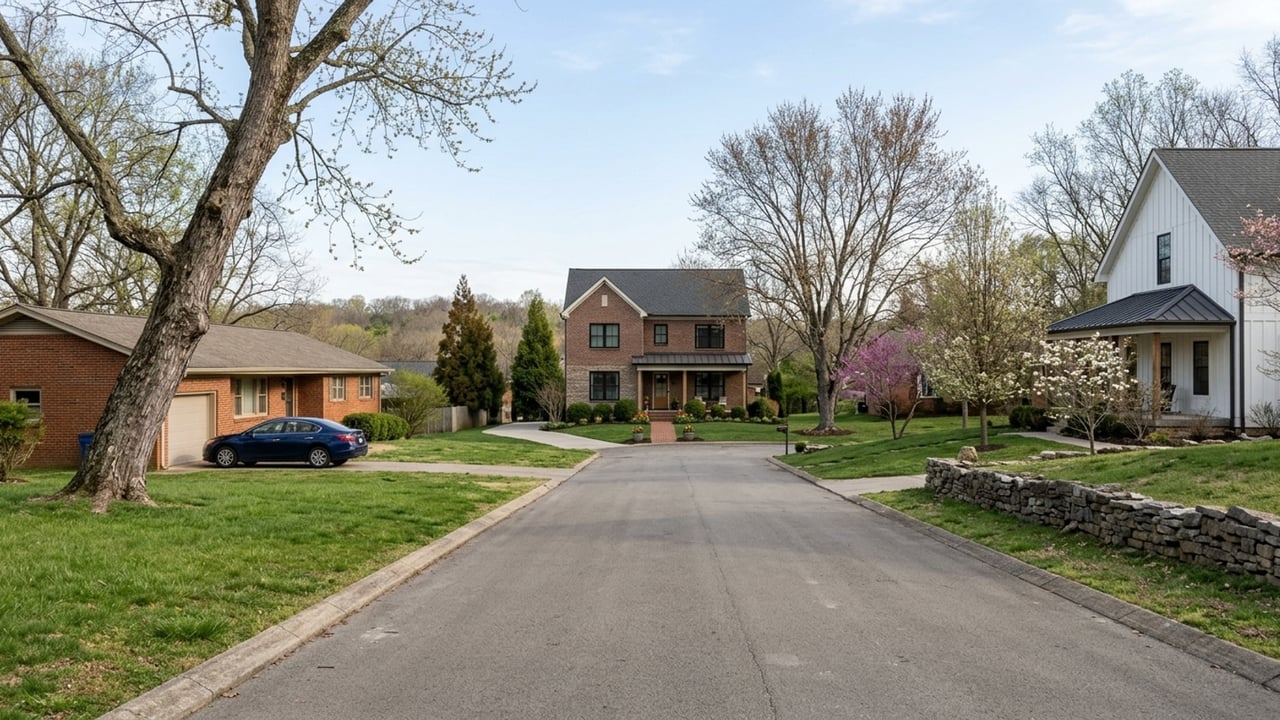
Home staging in Franklin, TN: what to stage by property type and what it costs
Staging November 12, 2026
Staging November 12, 2026
Getting a house ready to sell means deciding where to put your time and money before the photographer shows up.
Stage a Franklin single-family house to win in its first weeks on the market, because competition is strongest there. Nearly one in five of these houses sold above list price in the 90 days ending September 30, 2026. Condo and townhouse sellers face slower markets, where staging's job is to shorten the wait. That makes a targeted approach like virtual photos or an occupied-home consultation more practical than a full furniture package.
You're getting a Franklin home ready to list and deciding how much staging, if any, is worth paying for before the listing photos are taken.
Staging should be scoped by what you're selling, because Franklin houses and condos sell at very different speeds. Single-family houses recently sold in a median of 50 days. Condos sat a median of 85 days (based on just 20 condo sales). A house seller has a short launch window to get right. A condo seller is paying to look good over a longer wait.
Presentation changes how buyers see a property. Per the National Association of Realtors' 2025 Profile of Home Staging, 83% of buyers' agents said staging made it easier for a buyer to visualize the property as a future home. In the same survey, 60% of buyers' agents said staging had an effect on some buyers, and 26% said it affected the majority of buyers' view of the home.
Houses are Franklin's tightest segment, with just 3.5 months of supply recently. Treat staging as a launch plan:
Buyers move quickly on well-presented homes in a market this tight, and the first impression sets the offers. The catch is timing. If photos go live before staging is finished, the listing's first impression is the unstaged version, and you can't relaunch a first week.
Condo sellers compete against a deep pool of listings, so staging is about standing out in photos and shortening the wait. Franklin has about a year's worth of condos for sale at the recent sales pace. The median sale price is down 6.5% year over year (based on 20 condo sales), so treat both figures as a direction rather than a firm rule.
Favor targeted, lower-cost moves: decluttering, booking a consultation, or using virtual staging if the unit is vacant. Before booking a physical stager, ask the HOA about rules for furniture deliveries, elevator reservations and move-in fees.
The catch is that presentation alone won't sell the unit. With values down and supply high, an overpriced condo stays unsold however it looks.
Professional staging furniture is usually rented by the month. A Franklin townhouse's median 82 days on market can easily outlast a minimum rental term. Townhouses sell close to asking but rarely spark bidding wars: only about 1 in 18 sold above list price recently.
Staging keeps the listing from going stale in photos over that long stretch. Focus on the main-floor living space, and make small outdoor areas look usable. The catch is the rental bill, so know the extension rate before you sign.
Each option trades cash for effort, and the right one depends on your budget, your timeline and whether the home is occupied.
The stager furnishes and accessorizes key rooms with rental inventory, producing the biggest visual change at the highest cost. In the Middle Tennessee market, vacant home staging typically runs about $2,500 to $7,500 or more for the initial install and first month. It is usually priced as a design and installation fee plus a monthly rental.
This is the best fit for an empty single-family house aiming for a strong launch. The catch is that the monthly rental keeps billing for as long as the home sits. An empty home also raises the insurance question covered under vacant homes below.
A stager walks through, provides a room-by-room list, and may rearrange your existing furniture. In Middle Tennessee, an initial home staging consultation typically costs about $250 to $600. It's the lowest professional spend and fits most occupied homes, condos and townhouses.
The catch is that you do the heavy lifting: packing, storing boxes and keeping the house ready while living in it.
Furniture is added digitally to listing photos of empty rooms using specialized software. Virtual staging for Nashville-area listings typically costs about $25 to $150 per photo. That is far cheaper than physical staging and well-suited to a vacant condo or townhouse where a monthly rental would outlast the sale.
What you give up is the in-person impact. Buyers walk into empty rooms at the showing, and if the photos oversell the space, the gap between the screen and reality works against you.
You declutter, deep-clean, neutralize, rearrange and refresh using your own furniture plus a few purchased accents. Cash costs are the lowest here, mostly cleaning supplies, touch-up paint and possibly a storage unit. Get a storage quote if decluttering means moving furniture out.
To get rid of large items, call the City of Franklin's Sanitation and Environmental Services at (615) 794-1516:
The real cost of DIY is your time, often in the same weeks you're packing to move. Your own furniture may also date the photos in ways that are hard to see when you live with it.
On a median-priced Franklin house, 1% of the sale price is about $9,700. On the median condo, 1% is about $4,360, though that rests on just 20 condo sales.
Compare a real staging quote and your monthly carrying costs (mortgage, HOA dues, utilities and insurance) against those amounts. A house seller can justify a bigger staging budget than a condo seller for the same preparation effort. These are medians, not your home, and staging doesn't guarantee any price change. Ask your listing agent for recent comparable sales before setting a staging budget.
Franklin townhouses recently sold for a median of $316 per square foot, condos for $323 (based on 20 sales), and single-family houses for $332. Buyers pay similar money per foot whatever the type, so every room needs to read as usable square footage. Empty or cluttered rooms make buyers feel they're paying for dead space.
These are the first listing photos buyers see:
Overgrown landscaping takes longer to fix than it looks. Schedule yard cleanup around the city's brush pickup rather than waiting until the week of photos.
These rooms carry most of the photo weight:
Avoid over-styling. Hold off on replacing counters or appliances right before listing unless recent comparable sales show buyers pay for it.
Give each room one clear purpose. Make the primary bedroom calm and uncluttered, and put fresh towels in the bathrooms. Stage a bonus or flex room as an office or guest space so buyers count it as functional area.
Don't stage a room as a bedroom if it can't be marketed as one. Check how each room is recorded and what your listing can legally call it before furnishing it that way. Never block windows or closets with furniture.
Pack early as if you've already moved, and keep a daily reset routine for showings. Store personal photos and collections, and plan where pets and daily-use items go during each showing.
The catch is that the house has to stay photo-ready for as long as it's listed. In the condo and townhouse markets, that can be a long stretch.
Empty rooms photograph smaller and colder, so stage at least the main living area and primary bedroom, physically or virtually. Keep your Franklin utilities connected so the power and water are on for photos, inspections and showings.
Standard homeowners policies in Tennessee commonly include a vacancy clause that suspends or limits certain coverages, typically vandalism, theft and water damage. It applies once a home has been unoccupied for 30 to 60 consecutive days, depending on the insurer and policy. Call your insurer about vacancy terms and ask whether rented staging furniture is covered.
Look for a portfolio of recent Franklin or Williamson County listings, proof of liability insurance and clear written contract terms. The Real Estate Staging Association (RESA), the industry's trade association, maintains a national member directory. It also offers a RESA-PRO designation for members who pass an ethics exam, have time in business and show proof of insurance.
Credentials vary widely. Home staging is not a licensed or regulated profession in Tennessee, so no state license or government certification is required to work as a stager. A portfolio and references tell you more than a title.
Get a written staging quote that covers:
The lowest quote often leaves out pickup, extension or damage-waiver fees. Compare the total cost over a realistic listing period for your property type, not just the first month.
Deciding how to present your property is just one part of selling a home in Franklin, especially if you're weighing a cash offer against an open-market MLS listing. Bill Diebenow can walk through the home and suggest which rooms are worth staging before photos. If you want professional guidance on preparing your property, reach out to the best real estate agent in Franklin to get started.
No Franklin-specific statistic links staging to days on market. The national NAR survey measures how buyers' agents see staging's effect on buyers' perception, not sale speed.
Yes. Under Realtracs Rule 2.7, virtually staged photos are permitted in MLS listings as long as they're not deceptive to buyers. They must be designated as virtually staged in the media remarks and can't remove features outside the owner's control, like adjacent buildings or power lines. The Tennessee Real Estate Commission's ban on false or misleading advertising also applies to deceptive photo editing.
Ask each stager for its current lead time from consultation to installation. Then work backward from your photographer's date so the furniture is in place before the camera arrives.
Staging is normally a seller expense. Some agents or brokerages include a consultation or offer to advance costs, so ask your listing agent what their marketing plan covers and get it in writing.
IRS Publication 523 lets you subtract selling expenses, including "any other fees or costs to sell your home," from the selling price. Tax professionals commonly treat staging as falling in that category, though the publication doesn't name staging, so confirm with a tax professional.
It depends on your policy and how long the home has been empty, given the vacancy limits described above. Confirm with both your insurer and the stager who covers damage or theft.
Tennessee real estate tips and insights.
Middle TN
Bill Diebenow | November 12, 2026
Pricing
Bill Diebenow | November 12, 2026
Home
Bill Diebenow | November 12, 2026
Home
Bill Diebenow | November 12, 2026
Home
Bill Diebenow | November 12, 2026
Search
Bill Diebenow | November 12, 2026
Bill's real estate experience spans residential and commercial transactions as an agent, buyer, seller, investor, tenant, landlord, and cross-county corporate relocation. Bill looks forward to understanding your needs, building your trust, and helping you successfully sell your existing home, find your new home, or add to your real estate portfolio.

Bill Diebenow
3990 Hillsboro Pike Suite 320 Nashville TN 37215