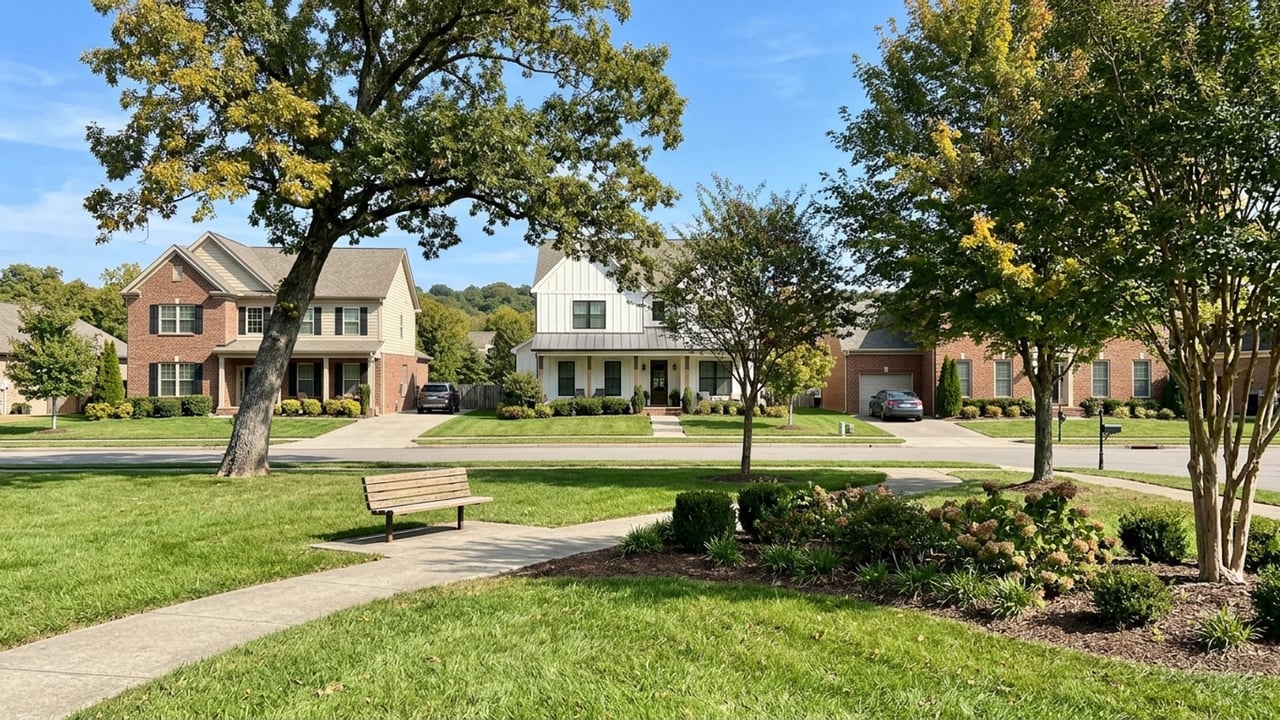
How long to sell my home in Franklin, TN: days on market by property type
Pricing November 12, 2026
Pricing November 12, 2026
The median time a home spends on the market in Franklin is about 55 days, but that citywide number blends completely different property types together. When you're planning a move, relying on a broad average can leave you carrying two mortgages or rushing to pack.
If you're selling a single-family home in Franklin, plan on a median of 50 days to an accepted offer, plus the closing period. Houses move fast enough that a well-priced listing rarely needs a cash-buyer shortcut. Townhouses and condos take closer to three months, so build that extra month into your move date before you start thinking about cutting the price.
You own a home in Franklin and are deciding when to list, how much time to budget before your move, and whether waiting on the open market is worth it.
Redfin tracks days on market from the day a property is listed to the day the seller accepts an offer. It measures the time it takes to find a buyer, not the time it takes to close the loan. The citywide median of 55 days averages together very different markets.
Your home type sets your clock. Buyers shopping for a detached house face different inventory levels than those looking at townhouses or condos, and that changes how quickly they write offers. The data below covers the 90 days ending September 30, 2026.
This is the fastest and most competitive property type in the city. A well-priced house typically goes under contract in a median of 50 days, and nearly one in five Franklin houses sold for more than the asking price over the last 90 days.
Price against recent comparable sales in your subdivision, and you can expect strong interest. The median does hide price bands, though. A house listed above what recent comparable sales support doesn't sell at that pace and can sit as long as a condo. The speed comes from the list price, not from the market.
Townhouses are slower but not discounted. They take a median of 82 days to go under contract, about a month longer than detached houses, yet they still close at 98% of the list price.
If you're at day 60 with steady showings, you're on schedule. A price cut at that point may give away money the market wasn't asking for.
What you do give up is time and holding costs. The extra month means another month of mortgage, HOA dues, and utilities on a home you're trying to leave. HOA resale paperwork can also add time at the end, so ask your HOA now how long a resale certificate takes to process and what it costs.
Condos are the slowest property type and the only one where buyers clearly hold the stronger negotiating position. Based on a small sample of 20 condo sales, the median time on market was 85 days. At the current pace, there are about 12 months' worth of condos for sale in Franklin.
A year of supply means buyers can compare many units side by side without feeling rushed. Price against the closest active competition rather than last year's sales figures. With this little sales data, one or two sales can swing the numbers, so get the active and pending condo count in your complex before you set the price.
Start with your property type, because it sets your baseline days on market more than anything else. Find the matching profile under "How long does it take to sell a house in Franklin, TN?"
If you have a fixed move or closing date, count backward using "The home-selling timeline, step by step." Take a single-family seller who wants to be out by a set date. They subtract the loan closing period from that date, then the single-family median days on market, then however many weeks it takes to prepare the house for photos. That puts the list date roughly three months before the move, plus prep time. If the math doesn't fit, read "Listing vs. selling for cash in Franklin."
If several homes like yours are listed nearby, read "Pricing against competing listings" before you set a price. If your listing has already passed the median for its home type with few showings, go to "When to reduce the price."
Bill Diebenow can pull current days on market for comparable homes in your subdivision to help you map out a precise calendar.
A sale runs in three stages, and only the middle one shows up in days on market. Add all three to find your real move date. Proper preparation for selling a home in Franklin, TN keeps these stages moving smoothly.
Prep extends your total timeline without appearing in market statistics. This stage covers repairs, cleaning, decluttering, and professional photos. You'll also need to complete the Tennessee seller disclosure form.
Get contractor availability dates in writing before you pick a list date. Waiting on a painter or a plumber can push a listing back by weeks.
Every week spent on prep is a week not on the market. Small fixes that buyers will flag help the sale, but large renovations rarely pay back in time or money. Weigh the cost against the likely sale-price impact before you start.
Flexible showing access, a vacant or staged home, and pricing at comparable sales from the first weekend all help shorten this stage. Most buyer interest arrives in the first weeks of a listing, which makes the launch the most important part of the process.
Negotiations over price, closing costs, and move dates happen here. The stage ends when both parties sign the purchase agreement and the listing goes under contract.
Restrictive showing windows or a tenant-occupied home lengthen this stage by cutting buyer traffic. Ask your agent how many showing requests were declined or rescheduled to see if access is the problem.
A home that has gone under contract still has its financing and closing period ahead of it. This stage includes the inspection and resolution period under the Tennessee REALTORS purchase agreement. That period has no fixed length: it is negotiated, commonly 7 to 14 days, though it can be whatever the parties agree upon. The stage also includes the appraisal, loan underwriting, and title work.
ICE Mortgage Technology reported that the average purchase loan recently closed in 36.8 days. Cash buyers can skip the financing and appraisal steps entirely. Your move date is the contract date plus this closing period, not the listing date plus days on market.
A failed inspection negotiation or a buyer's loan denial can send the home back on the market and restart the showing stage. Ask buyers for full pre-approval documentation, not just a pre-qualification letter, before you accept an offer.
Buyers weigh your property against the other homes they can tour that same weekend. When a listing outlasts its type's median, they are usually finding better value in price, condition, or ease of access elsewhere.
Buyers compare you with what's for sale today. Single-family homes recently had 3.5 months of supply, while townhouses sat at 4.2 months. Townhouse sellers therefore face more side-by-side comparison, which helps explain their longer wait even when they achieve a strong sale-to-list ratio.
Citywide supply can look healthy while your street has three near-identical homes listed. Local competition, not the city figure, decides your days on market, so ask your agent for the active and pending listings in your subdivision and price band. Buyers also build property tax rates and the cost of living into the monthly payment they can afford.
At the single-family median sale price of $969,613, the typical Franklin house sold about $18,400 below its list price. If your list price sits well above recent comparable sales, normal negotiating room won't close that gap, and the listing will outlast its type's median.
Condo median sale prices fell 6.5% year over year (based on 20 condo sales), so treat that figure with caution. A stale condo listing becomes a pricing signal sooner than a stale townhouse. Use the median days on market for your property type as the checkpoint for considering a reduction.
Every reduction is visible in the listing history, and buyers read it as room to negotiate further. One well-sized adjustment reads better than several small ones.
Condition issues are a time cost separate from prep. Items that inspectors and buyers flag become renegotiations after the contract is signed, which can push back or break a closing.
A pre-listing inspection can help you get ahead of this. Confirm any open permits or unpermitted work with the City of Franklin before you list.
Fixing everything an inspector might find can cost more time than the repairs save. Prioritize safety, roof, mechanical, and water issues, and confirm your priorities with your own inspector.
Cash-buyer offers promise speed, but whether you need it depends on your home type. For single-family homes, the data suggests waiting on the open market usually costs little in final price. For condos facing that much supply, or sellers on a hard deadline, a cash offer's speed may matter more than getting every last dollar.
To compare a cash offer against an MLS listing, start by requesting a mortgage payoff statement from your lender to confirm what you owe at closing. Then get the cash offer's net proceeds in writing and compare them with a listing net sheet at a realistic sale price. Bill Diebenow can prepare a net sheet for both routes so you can see the exact difference in your pocket.
Commissions are negotiable, and a 3% or 6% fee is a historical convention, not a standard. Since August 17, 2024, under the NAR settlement, sellers can still offer compensation to a buyer's broker, but only outside the MLS, and MLS Participants must have a written buyer agreement before touring a home with a buyer. Ask any listing agent to put their fee and what it covers in the listing agreement.
Every 1% of commission on the $863,089 all-homes median sale price is about $8,630. Ask your agent for the exact percentage or flat fee in writing.
It is an informal rule of thumb with several versions, not a legal or industry standard. Judge your Franklin timeline against the days-on-market median for your home type instead.
Williamson County statements are mailed in early October, and taxes are due from the first Monday in October through February 28 of the following year. Taxes are typically prorated between buyer and seller at closing, and the title company calculates the split.
Your home type affects Franklin timelines more than the season does. List well before your target moving month, allowing for your type's median days on market plus closing.
Under the IRS Section 121 exclusion, you must have owned and used the home as your main home for at least two of the five years before the sale. That lets you exclude up to $250,000 of gain, or $500,000 for married couples filing jointly. Tennessee doesn't tax individuals' capital gains: the Hall income tax, fully repealed beginning January 1, 2021, never applied to them. Confirm your situation with a tax professional.
Tennessee real estate can't be sold within 30 days of the date of death, and it's ideal to wait until creditor claims have expired. If probate hasn't been opened, that is up to one year from the date of death. Real property vests immediately in the heirs or devisees unless the will directs that it be administered through the estate and gives the executor that authority.
Tennessee is not a mandatory attorney state, and most residential transactions close through title companies or escrow agents. Sellers may still choose an attorney for estates, title problems, or for-sale-by-owner deals.
Tennessee real estate tips and insights.
Middle TN
Bill Diebenow | November 12, 2026
Pricing
Bill Diebenow | November 12, 2026
Home
Bill Diebenow | November 12, 2026
Home
Bill Diebenow | November 12, 2026
Home
Bill Diebenow | November 12, 2026
Search
Bill Diebenow | November 12, 2026
Bill's real estate experience spans residential and commercial transactions as an agent, buyer, seller, investor, tenant, landlord, and cross-county corporate relocation. Bill looks forward to understanding your needs, building your trust, and helping you successfully sell your existing home, find your new home, or add to your real estate portfolio.

Bill Diebenow
3990 Hillsboro Pike Suite 320 Nashville TN 37215