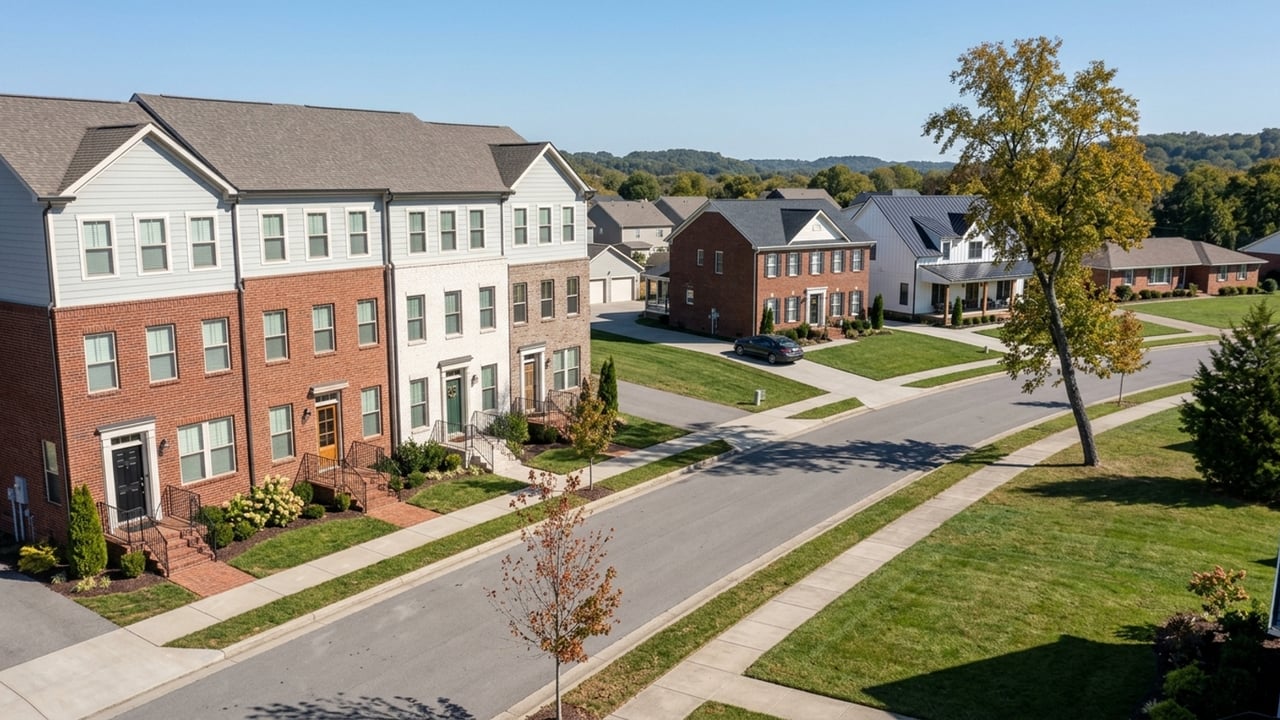
Investing in Franklin, TN real estate: market data by property type, strategies, and costs
Search November 12, 2026
Search November 12, 2026
Investors looking at Middle Tennessee keep landing on Franklin. The city's growth and proximity to major employers make it a frequent target for property buyers. But buying an investment property here requires understanding a localized housing market.
What works for a primary residence doesn't always translate to a profitable rental or flip. You have to look closely at the numbers by property type to see where the real returns are.
For most investors, Franklin townhouses are the place to start. They gained 10.1% in value over the past year yet sell slowly enough to give you time to negotiate. Single-family homes offer the strongest appreciation at the highest entry price, while condos are the cheapest option but the one segment currently losing value.
You're weighing a Franklin purchase as a rental or long-term hold and need to decide which property type and strategy fit your budget, timeline, and expected source of return.
Franklin's investment returns split sharply by property type. Single-family houses carry the appreciation, up 14.8% year over year, but require the top entry price. Condos offer the cheapest door but are the one segment losing value, sitting on 12 months of supply based on 20 condo sales.
Townhouses represent the middle path. At a median $316 per square foot, they offer the lowest cost for space of any type, and prices are still rising while homes sit long enough for buyers to negotiate.
These numbers mean the investment potential has three different answers depending on what you buy. A citywide median hides the reality that returns here rely on appreciation and equity rather than immediate rental cash flow. You can review broader trends on the housing market page, and check the job market page to see the employer demand driving these prices.
These figures reflect Redfin data for the 90 days ending September 30, 2026. The condo figures rest on just 20 sales, so treat them as a rough signal rather than a firm trend.
The type of property you buy in Franklin dictates your negotiating power and your expected return. The market behaves differently depending on the asset class, from a detached house to a shared-wall community.
The splits above show where your budget fits and which asset class to target before you start writing offers.
If you want a lower entry price without buying into a segment that's losing value, start with townhouses. Slow sales and few above-list deals mean sellers expect offers under asking, which gives you time to inspect and negotiate terms.
In Franklin, townhouses cost less per square foot than condos, so the lower-priced condo isn't the better buy on space. The advantage here comes from time on the market; values are still climbing.
Don't expect deep discounts, though. Prices have not softened. Many townhouse communities also have HOA leasing rules or rental caps that can rule out renting entirely. Get the HOA documents before you offer.
If you want the strongest appreciation and can pay the top entry price, single-family homes are the target. This segment is where Franklin's price growth is concentrated, and bidding remains competitive. Nearly one in five Franklin single-family homes sold above asking in the latest 90 days.
You should expect to pay at or above asking on desirable houses, with little room to negotiate. The return case rests on continued price growth and building equity over time, not on generating monthly rental income. Supply is tight, you'll often be competing against owner-occupants, and a year of strong growth is not a forecast. If prices flatten, the investment case flattens with them.
If your priority is maximum negotiating room on a long hold and you can absorb near-term price declines, condos fit the bill. This is the cheapest door into the city, but it comes with the weakest numbers. Values are falling, and offers below asking are normal.
Condos cost nearly as much per square foot as houses, so the lower price buys a smaller unit, not cheap space. Only 1 of the 20 Franklin condos that sold in the latest 90 days went above asking.
Because values are dropping and resale is slow, an investor may sit on a paper loss and struggle to exit. HOA reserves, special assessments, and rental limits can erode returns further. Ask the HOA for its reserve study and leasing rules before you offer.
Translating these property types into a business plan means running the numbers against standard real estate rules of thumb. The high entry prices in Williamson County make certain traditional strategies difficult to execute.
If you plan to hold a property for a decade or flip it in a few months, the math has to align with current market realities. Here's how common investment approaches fare under current conditions.
A townhouse bought at the $615,007 median would need about $6,150 a month in gross rent to meet the 1% rule. FY2026 HUD Fair Market Rents for the broader Nashville-Davidson-Murfreesboro-Franklin metro area are $1,578 for a one-bedroom, $1,730 for a two-bedroom, and $2,211 for a three-bedroom. Get current rental comps from local property managers before relying on any estimate.
At Franklin prices, rents fall well short of that $6,150 target, so most purchases are an appreciation and equity play, not a cash-flow generator. Plan for thin or negative monthly cash flow unless you put more down.
This strategy matches the data for the city's strongest segment. Buying a single-family home and holding it for long-term equity capitalizes on the property type with the strongest price trend, and investors taking this route are banking on sustained demand in Williamson County.
Holding costs, including property taxes, insurance, and HOA dues, are the price of waiting for that equity to build. Past-year gains are not a forecast. If appreciation slows, carrying costs on a low-cash-flow property can outweigh the gain.
The 70% rule helps flippers set a maximum purchase price. Using the single-family median of $969,613 as the after-repair value, 70% is about $678,729. A buyer's maximum purchase price is that figure minus the estimated repair costs.
Franklin's sales pace makes finding these discounts difficult. With single-family homes selling in a median 50 days, few houses sit on the market long enough to become stale and trigger a deep price cut. Distressed single-family inventory is scarce and contested. Transfer tax and closing costs are paid on both the buy and the sell, which shrinks the margin.
Franklin regulates short-term vacation rentals under its Zoning Ordinance, specifically Section 2.2.4 Nonconformities. Properties legally permitted as short-term rentals before the ordinance's effective date retain grandfathered status until the property is sold, ceases the use for 30 continuous months, or violates local laws three times.
The City's Property Maintenance/Building and Neighborhood Services division verifies compliance. Confirm short-term rental permit eligibility for the specific address with the City of Franklin planning office.
City permit limits, zoning rules, and HOA bans can each rule out nightly rentals independently. Many Franklin subdivisions and condo associations restrict leases under a minimum term, so verify both before you buy.
Narrowing down a location starts with your chosen property type rather than a broad zip code search. Pull the last 90 days of sales for your property type in the specific subdivision, not just citywide figures. Localized data shows whether a specific neighborhood is outpacing or lagging behind the broader Franklin market. You can explore the guides to the best neighborhoods, most expensive areas, and local ZIP codes to map out these subdivisions.
Once you identify a subdivision, checking the community rules is the next step. Two public school districts serve the area: the Franklin Special School District covers part of the city for K-8, while Williamson County Schools serves K-12 for the rest and handles high school for FSSD students. Confirm school zoning with Williamson County Schools or Franklin Special School District directly; never rely on a listing's claim. You can also review the safety page to understand how local law enforcement tracks and reports crime data across different sectors of the city.
The purchase price is only the starting point for calculating your potential return. Ongoing holding costs and one-time transaction fees dictate how much capital you need to keep the property running.
Estimating these expenses accurately prevents cash-flow surprises after closing. Verify current rates and community fees during the inspection period.
Franklin owners pay property taxes to both Williamson County and the City of Franklin. You can review the cost of living guide to see how these dual rates apply to assessed values.
Reappraisals can raise your assessed value after you buy. Budget your hold using current assessments, not the seller's old bill.
Tennessee charges a statewide realty transfer tax of $0.37 per $100 of the sale price or property value, whichever is greater. This recordation tax applies uniformly across Williamson County.
The buyer typically pays this tax, though it remains a negotiable item in the contract. Confirm with your closing attorney or title company who pays the transfer tax and recording fees in your contract.
Flippers and short-hold investors pay these costs twice, which can erase a thin margin.
Most Franklin townhouses and condos, along with many single-family subdivisions, operate under homeowner associations. These organizations dictate what you can and cannot do with your investment.
Ask the HOA for current dues, any recent or planned special assessments, and the latest reserve study. You also need its leasing rules, specifically checking for rental caps, minimum lease terms, and any short-term rental bans. A rental cap or lease minimum discovered after closing can turn a planned rental into an unplanned owner-occupied home.
Landlord insurance policies generally cost more than standard owner-occupant coverage. Parts of Franklin lie along the Harpeth River floodplain, and the city currently has 1,769 properties determined by FEMA to be in a flood zone.
Check the address on the FEMA flood map and get landlord insurance quotes before making an offer. A flood-zone designation can add a required flood policy that changes the rental math entirely.
The right property depends on how you answer a few basic questions about your timeline and budget. Will your return come mainly from rent or from price growth? If you expect returns from rent, run the worked example in the long-term rentals section before anything else. If you expect returns from growth, start your search with single-family homes.
If your entry budget tops out well below the single-family median, compare townhouses and condos, and read the catch for each before choosing the cheaper door. If you might need to sell within a few years, weigh the days-on-market figures in the at-a-glance list and the catch in the condos section. If you plan to rent by the night or to tenants on short leases, read the short-term rentals and HOA sections first, because either can rule a property out.
Bill Diebenow can pull 90-day sales for a specific subdivision and property type to help you evaluate a potential deal. This article provides market information, not investment or tax advice.
No, not overall. The median sale price for all homes is $863,089, up 12.8% year over year based on 437 homes sold. Condos are the only property type that recently fell in value.
HUD Fair Market Rents for this metro area are listed in the long-term rentals section above. Market rents can differ from HUD figures. Confirm current comps with local property managers before estimating your rental income.
Franklin's home values reflect high demand and population growth, pushing the median price per square foot for all homes to $326. You can review the job market page to see the local employers driving much of this housing demand.
Franklin is its own city in Williamson County, located approximately 20 to 22 miles south of downtown Nashville. This is roughly a 25 to 35-minute drive via I-65 under normal traffic conditions. This proximity attracts commuting renters, which affects rental demand for investors.
Tennessee has no state personal income tax, and the state fully repealed its Hall income tax on interest and dividends in 2021. Federal tax still applies to rental income. Confirm your specific tax situation with a CPA.
The City of Franklin does not have a general long-term rental property registration or inspection ordinance. It does require permits for short-term vacation rentals through its electronic plan review portal. Confirm any rental registration or inspection requirement with the City of Franklin before leasing, and check for HOA approval if the community requires it.
Tennessee real estate tips and insights.
Middle TN
Bill Diebenow | November 12, 2026
Pricing
Bill Diebenow | November 12, 2026
Home
Bill Diebenow | November 12, 2026
Home
Bill Diebenow | November 12, 2026
Home
Bill Diebenow | November 12, 2026
Search
Bill Diebenow | November 12, 2026
Bill's real estate experience spans residential and commercial transactions as an agent, buyer, seller, investor, tenant, landlord, and cross-county corporate relocation. Bill looks forward to understanding your needs, building your trust, and helping you successfully sell your existing home, find your new home, or add to your real estate portfolio.
Bill Diebenow
3990 Hillsboro Pike Suite 320 Nashville TN 37215