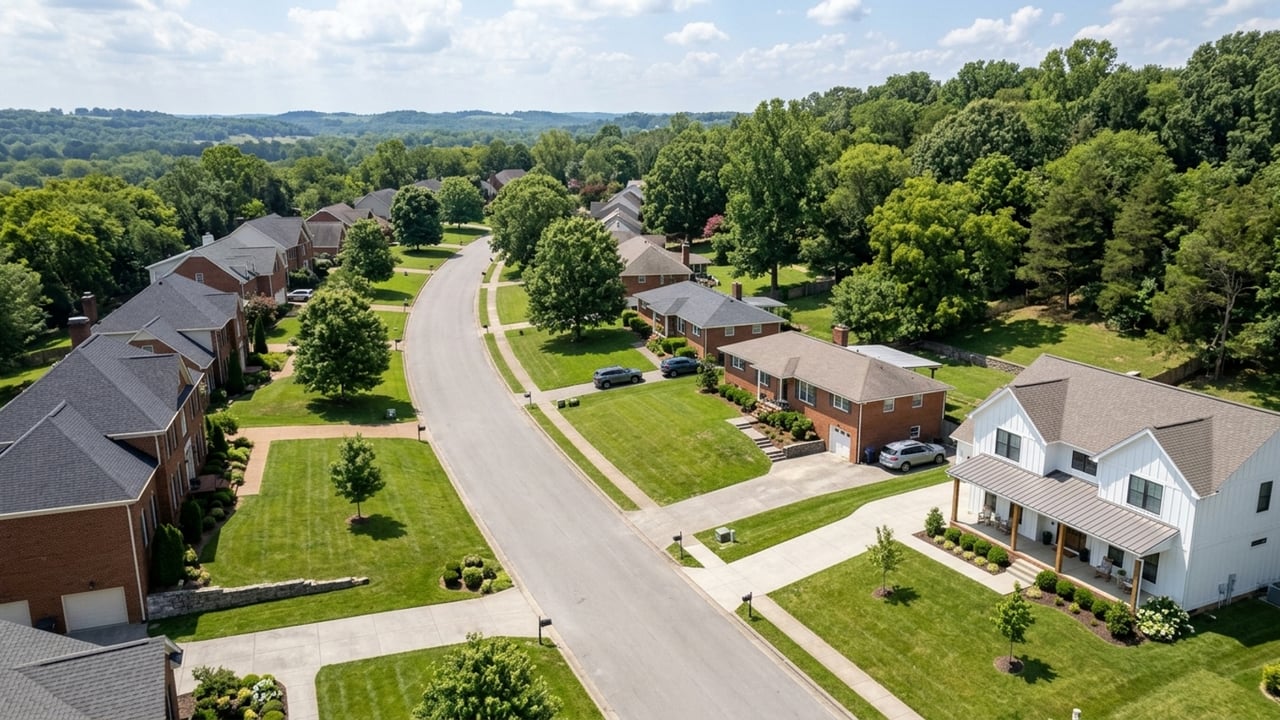
Seller disclosures in Franklin, TN: Tennessee rules, forms & local issues
Pricing November 12, 2026
Pricing November 12, 2026
Getting a home ready to sell in Franklin, TN involves more than staging and pricing. Under state law, you must provide buyers with specific documentation about the property's condition before accepting an offer.
The paperwork you choose and the details you provide directly affect your bottom line. A thorough, well-documented property condition report gives buyers confidence, while missing information can lead to renegotiations or lost deals.
Tennessee sellers must provide either the state's property condition disclosure or an as-is disclaimer statement, but in Franklin, the full disclosure with repair records is usually the stronger choice. Homes take a median 55 days to sell, giving buyers time to read it, inspect, and renegotiate. The disclaimer mainly fits estate, investor, or as-is sales priced to match.
You're getting ready to list a Franklin home and need to decide which Tennessee disclosure document to sign, what to put on it, and what records to gather before buyers start asking.
In Franklin's current market, homes take a median 55 days to sell, there's four months of supply, and only 16.3% sell above list. That makes the Tennessee disclosure statement a negotiating document rather than mere paperwork. Buyers aren't rushing to waive inspections or overlook condition issues. They have time to read the disclosure line by line, order inspections, and compare notes.
When an inspector finds a defect you didn't disclose, buyers use that gap to ask for credits, demand repairs, or walk away. A complete, documented disclosure protects your asking price by putting known issues on the table upfront. A bare as-is disclaimer costs the most for condo and townhouse sellers, whose homes take 82 to 85 days to sell and close above list only about 5% of the time.
Your choice comes down to this: disclose fully and document the condition, or disclaim and price the home for the uncertainty. Check local Franklin housing market trends to see how fast homes like yours are moving. For questions about how the law applies to a specific property, consult a Tennessee real estate attorney.
If you've lived in the home, you'll need to complete the standard paperwork. If you're selling as an executor, trustee, lender, or builder, read the section on exempt sales first, then look at the disclosure versus disclaimer choice. Fiduciary and new construction sales follow different rules under state law.
When the home is a condo or townhouse governed by a homeowners association, go straight to the HOA documents section. Attached homes require specific community financial and governance records. If the property sits on septic or a private well, near the Harpeth River, on karst ground, or inside a historic overlay district, check the section on Franklin property issues.
For homes built before 1978, federal rules apply regardless of what the state form requires. Review the federal and other required disclosures section for the lead-based paint rule. This helps you skip the sections that don't match your property type or ownership status.
Under the Tennessee Residential Property Disclosure Act, sellers of one-to-four unit residential properties must furnish a buyer with either a condition disclosure statement or a disclaimer statement. The disclaimer is permitted only where the buyer waives the required disclosure. This document must be delivered to the buyer before the acceptance of a purchase contract.
The Tennessee Real Estate Commission doesn't publish a standardized form itself, as the required content is codified in state law. The statewide Realtor association, Tennessee REALTORS, publishes the widely used standardized version, Form RF 201. The current published version on file is dated January 1, 2026.
This form covers the condition of the property as known to the seller and is not a warranty or a substitute for an inspection. It records what you know firsthand, not what a professional inspector might find. The document carries your signature, so a vague or careless answer becomes a written representation a buyer can rely on later.
Confirm with your listing agent or the Tennessee Real Estate Commission that you're using the current version of the form. The law holds you to a good-faith standard based on your actual knowledge at the time, which offers no cover for intentional ignorance or omitted repairs.
Tennessee gives sellers the option to provide a disclaimer statement instead of the full condition disclosure. This means the property is sold as-is, the seller makes no representations, and the buyer may inspect the home. The buyer must explicitly waive the required disclosure for the disclaimer to be valid.
Certain disclosures survive even an as-is disclaimer sale under state law. Sellers must disclose in writing the presence of any known exterior injection well, percolation test or soil absorption rate results, and known sinkholes. The sinkhole duty applies regardless of whether the sinkhole shows up on the property's recorded plat map contour lines. Sellers must also disclose in writing if the property is located in a Planned Unit Development and provide restrictive covenants or bylaws upon request. Signing a disclaimer does not remove these specific written disclosure duties.
Single-family homes in Franklin sold above list 19.3% of the time recently, so a competitive offer on a house is worth protecting with a documented disclosure. A full disclosure leaves little room for a buyer to renegotiate later. A disclaimer can make sense for a home priced as-is for investors or a seller with no firsthand knowledge of the property.
The downside to a disclaimer is that it can signal unknown problems to buyers, drawing lower offers or heavier inspection demands because buyers assume they'll find expensive repairs.
The standard Tennessee REALTORS form asks you to check boxes regarding the condition of the structure, roof, foundation, and any water intrusion. It covers mechanical systems like your HVAC, plumbing, and electrical setup. You'll also answer questions about the water and sewer source, environmental conditions, HOA matters, and legal items like encroachments, easements, or pending assessments.
For each area, gather the records that support your answer: a roof replacement invoice, an HVAC service log, a building permit. The law holds you to an actual-knowledge standard, meaning you must answer based on what you know to be true. Answer "unknown" honestly rather than guess about a system you've never repaired or inspected.
Answering "no" to a defect you repaired without mentioning the repair is a common source of later disputes. The repair belongs on the form along with its receipt to show the problem was resolved.
While there's no official county-specific sinkhole map for Williamson County, peer-reviewed geologic research published in Hydrogeology Journal shows the state offers a general geologic hazards map showing karst areas. If you know about a sinkhole on your lot, you must disclose it under state law. Failing to mention known karst features can lead to severe liability if the ground later subsides.
The City of Franklin's Floodplain Management program notes that the Harpeth River and its tributaries pose the biggest flood risk in the city. There are 1,769 properties determined by FEMA to be in the floodplain, specifically in the Special Flood Hazard Area known as the AE Zone. Look up your address on the FEMA flood map and note any past water intrusion or flood insurance claims. Buyers will check this data.
For homes outside the city sewer system, you must disclose what you know about the septic system and any soil absorption rates. Request your septic permit and any percolation test records from the county. Missing septic records can delay closing while the buyer waits for the county health department to verify the system's capacity.
If your property relies on a private well, that information goes directly on the state form. A water quality test is typically required during the inspection period when a well is involved.
The City of Franklin's Historic Zoning Commission reviews proposed exterior alterations within the Historic Preservation Overlay to determine if changes would damage the district's value. Ask City of Franklin planning whether your parcel sits in a historic overlay district. Leaving this off the disclosure blindsides buyers who plan to renovate, as they'll suddenly face strict design guidelines and approval processes based on Franklin history.
Franklin condos took a median 85 days to sell with 12 months of supply recently, based on 20 sales, while townhouses took 82 days. Only 5.5% of townhouses sold above the asking price. Condo and townhouse buyers have plenty of other options and time to compare, so missing HOA paperwork or an unexplained special assessment gives them an easy reason to move on.
Tennessee doesn't have a statutorily named resale certificate requirement in the Tennessee Condominium Act of 2008 in the way some other states do. The Act does require disclosure for units restricted to residential purposes, and the declarant or association must provide prospective purchasers with financial and insurance information.
Sellers in Franklin's master-planned communities should gather the HOA budget, reserve information, rules, and details on any pending assessments or litigation. Ask your HOA or management company for current dues, any approved or pending special assessments, and the fee and turnaround for a resale package.
You don't control how fast the HOA produces documents. Order them before listing, not after an offer arrives.
Under federal law, every seller of residential property built before 1978 must disclose known lead-based paint hazards to the purchaser. You must provide any available records, give the purchaser the EPA lead hazard information pamphlet, and obtain a signed acknowledgment before the sale is finalized. This rule applies to most pre-1978 housing and gives the buyer a chance to inspect, though it doesn't require you to test or remove the paint.
Check the year built on Williamson County property assessor records to see whether the federal lead-paint rule applies to your home. This is especially relevant to older downtown and near-downtown Franklin properties.
Tennessee also has strict rules regarding clandestine drug labs. Under state law, law enforcement may quarantine property where methamphetamine has been manufactured, and it's prohibited for anyone to inhabit or offer the property for habitation. A notice of quarantine is recorded with the county register and stays in effect until the property is decontaminated by a certified cleanup contractor.
These rules sit outside the standard state form. A seller who completes only the standard paperwork can still miss these federal and state mandates.
Tennessee law exempts certain property transfers from the standard condition disclosure requirement. Confirmed exempt categories include transfers via foreclosures and bankruptcies, new construction accompanied by a written warranty, and sales where the seller has not occupied the property within the past three years. This covers estate and trust sales by executors who never lived in the home, lender-owned properties, and the first sale of a newly built house.
An exemption from the state form doesn't erase fraud liability or the federal lead-paint rule. You still can't actively conceal known defects or lie to a buyer who asks a direct question. Ask a Tennessee real estate attorney whether your specific sale qualifies for an exemption or suits a disclaimer.
Being exempt rarely helps your final sale price, because buyers still want information about the property. Exempt sellers often supply known reports, surveys, and receipts anyway to keep buyers comfortable with the transaction.
Tennessee law requires the disclosure or disclaimer to be delivered to the buyer before acceptance of a purchase contract. Sellers typically provide the completed document to their listing agent, who uploads it to the multiple listing service so buyer agents can download it before writing an offer. Buyers acknowledge receipt by signing the bottom of the form when they submit their contract.
Sellers have a continuing duty to update the disclosure, certifying any changes that have occurred since the initial disclosure or confirming there are none. If a storm damages the roof between the contract date and closing, you must update the form to reflect the new damage.
Complete the form before the listing goes live so it's ready for the first showing. An update after a contract is signed can reopen negotiations, so the earlier you find and disclose an issue, the less room it hands the buyer to push for concessions.
When a seller fails to disclose a known defect, the practical consequences escalate quickly. Inspection findings that contradict the form lead to immediate repair requests or demands for financial credits. If the seller refuses, the buyer will likely terminate the contract during the inspection period and take their earnest money back.
If the defect goes undiscovered until after closing, the buyer may file a post-closing claim for misrepresentation or fraud. State law limits your liability to what you knew when you completed the paperwork, but that protection vanishes if you intentionally ignore a problem or omit a past repair. There are strict deadlines for filing these lawsuits, which are covered in the FAQ section below.
The cheapest moment to deal with a defect is before listing. Hiding a problem almost always costs more than fixing it or pricing the home accordingly from the start.
Preparation starts with gathering all documentation related to the home's maintenance and history. Collect repair and replacement receipts, warranties, past inspection reports, and your current survey. For properties with an HOA, order the resale package. For rural homes, pull the septic and well records.
Ask the City of Franklin for permit history on additions, decks, finished basements, and major system replacements. Track down your flood insurance history if the home sits near a waterway. Having these documents in hand lets you answer the form's questions accurately and attach proof of the work you've done.
Consider a Franklin townhouse seller listing near the recent median price of roughly $615,000. A seller who repaired a roof leak but leaves it off the form faces a buyer whose inspector spots the patch. For illustration only: a $10,000 credit request would be about 1.6% of that median price, and a disclosed repair with an invoice usually leaves the buyer less room to push.
Preparation takes days, and HOA, permit, and septic records each run on someone else's timeline. If you need help organizing these local records before you list, contact the relevant county offices directly.
No, home sale prices are public record in Tennessee. When a deed is recorded, the grantee or their agent must state under oath the actual consideration or value for the transfer. This sworn amount becomes part of the public record at the county Register of Deeds, and false statements are punishable as perjury.
No, Tennessee law treats a death on the property as a non-material fact. A seller has no duty to disclose that the property was the site of a homicide, felony, or suicide. Federal fair housing law also protects an occupant's health status, so sellers and agents should not volunteer it.
It depends on the timing of the delivery and the contract terms. Tennessee law requires delivery before acceptance of a purchase contract, and buyers who receive the disclosure before signing have no statutory right to cancel on that basis alone. Buyers should check their contract's inspection deadline to understand exactly when their right to terminate expires.
A purchaser's action for a seller's misrepresentation on a residential property disclosure statement must be commenced within one year. The clock starts at the earliest of the date the purchaser received the disclosure statement, the date of closing, or occupancy by the purchaser. Fraud claims may follow different rules, so buyers should consult an attorney.
No. The Tennessee Residential Property Disclosure Act limits your liability to your actual knowledge when you signed the form. However, you cannot claim ignorance to avoid disclosing a known defect, nor can you hide behind this standard if you intentionally left past repairs off the paperwork.
Yes, real estate licensees have a separate duty to disclose adverse facts they know about, independent of the seller's form. Telling your agent about a hidden problem doesn't keep it from buyers. The agent must disclose known adverse facts to all parties.
Tennessee real estate tips and insights.

Middle TN
Bill Diebenow | November 12, 2026
Pricing
Bill Diebenow | November 12, 2026
Home
Bill Diebenow | November 12, 2026

Home
Bill Diebenow | November 12, 2026
Home
Bill Diebenow | November 12, 2026
Search
Bill Diebenow | November 12, 2026
Bill's real estate experience spans residential and commercial transactions as an agent, buyer, seller, investor, tenant, landlord, and cross-county corporate relocation. Bill looks forward to understanding your needs, building your trust, and helping you successfully sell your existing home, find your new home, or add to your real estate portfolio.

Bill Diebenow
3990 Hillsboro Pike Suite 320 Nashville TN 37215